Is Time Real or a Mental Construct?
Time governs every aspect of human experience. We remember the past, act in the present, and anticipate the future. Yet, when examined deeply—through philosophy, neuroscience, and theoretical physics—time begins to lose its solid footing. Many thinkers argue that time, as we perceive it, may not be a fundamental feature of reality but an illusion created by consciousness.
This chapter lays the philosophical groundwork of Shadow of Time by questioning whether time truly exists or whether it is a cognitive framework imposed by the human mind to make sense of change.
The Human Perception of Time
Human experience of time is deeply subjective. Psychological studies show that time can feel faster or slower depending on emotion, attention, and memory. A joyful moment seems fleeting, while suffering stretches endlessly. This elasticity suggests that time is not experienced uniformly, even though clocks insist otherwise.
Neuroscience supports this view. The brain does not contain a dedicated “time organ.” Instead, time perception emerges from neural processes such as memory sequencing, sensory integration, and anticipation. What we call the “present moment” is actually a reconstruction created milliseconds after sensory input is processed.
Thus, time may not be something we directly perceive—it may be something we infer.
Philosophical Perspectives on the Illusion of Time
Ancient Philosophy
- Parmenides (5th century BCE) argued that change is an illusion and that reality is eternal and unchanging. If change is unreal, then time—which depends on change—must also be unreal.
- Buddhist philosophy similarly views time as an illusion arising from attachment and impermanence. Past and future are mental constructs; only awareness exists.
Classical Western Philosophy
- St. Augustine famously questioned time’s existence, noting that the past no longer exists, the future does not yet exist, and the present vanishes instantly. He concluded that time exists only in the mind—as memory, attention, and expectation.
- Immanuel Kant proposed that time (and space) are a priori intuitions—structures of human perception, not properties of the external world. According to Kant, we do not experience reality as it is, but as our minds organize it.
Physics and the Challenge to Time’s Reality
Time in Classical Physics
In Newtonian physics, time is absolute—flowing uniformly everywhere in the universe. This view aligns well with human intuition but fails under modern scrutiny.
Relativity and the Breakdown of Universal Time
Albert Einstein’s theories of relativity shattered the notion of a universal present.
- Time slows down depending on speed (special relativity).
- Time flows differently in gravitational fields (general relativity).
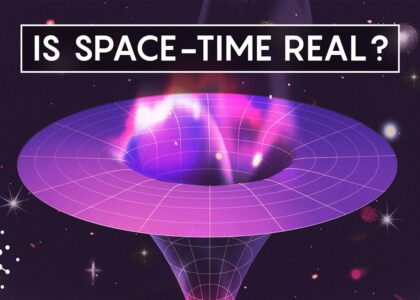
There is no single “now” shared by the universe. Events that appear simultaneous to one observer may not be so to another. This undermines the idea of an objective present and suggests that past, present, and future may coexist.
The Block Universe Theory
One of the most compelling implications of relativity is the Block Universe (or Eternalism).
According to this view:
- The universe is a four-dimensional spacetime structure.
- All moments—past, present, and future—exist equally.
- Time does not “flow”; rather, consciousness moves through spacetime.
From this perspective, the passage of time is an illusion, much like the illusion of motion in a flipbook. Reality simply is.
The Arrow of Time: Why Does Time Feel One-Directional?
If time is an illusion, why do we experience a clear direction—from past to future?
The answer lies in entropy.
- The Second Law of Thermodynamics states that entropy (disorder) tends to increase.
- Memory formation, biological aging, and causality all depend on increasing entropy.
We remember the past because it had lower entropy. The future is unknown because it has higher entropy. Thus, the arrow of time may be psychological and thermodynamic, not fundamental.
Time Without Time: Quantum and Modern Views
Some modern physicists argue that time may not exist at the deepest level of reality.
- In certain formulations of quantum gravity (such as the Wheeler–DeWitt equation), time disappears entirely.
- Physicist Carlo Rovelli argues that time is an emergent phenomenon—arising from statistical behavior, not fundamental laws.
At the quantum level, the universe may be governed by relationships and probabilities, with time emerging only when systems become large and complex.
Conclusion: Time as a Cognitive Construct
The illusion of time arises from:
- Human consciousness organizing experience sequentially
- Memory distinguishing “before” and “after”
- Entropy giving direction to physical processes
Rather than being a flowing river, time may be a map drawn by the mind—useful, necessary, but not ultimately real.
This realization forces a profound question:
If time is an illusion, then what is reality when stripped of past and future?
This question sets the stage for the deeper exploration of spacetime, relativity, and consciousness in the chapters ahead.
References & Further Reading
Philosophy
- Augustine, Confessions, Book XI
- Kant, I. Critique of Pure Reason
- Parmenides, On Nature
- Nāgārjuna, Mūlamadhyamakakārikā
Physics & Time
- Einstein, A. Relativity: The Special and the General Theory
- Minkowski, H. “Space and Time” (1908)
- Rovelli, C. The Order of Time
- Barbour, J. The End of Time
- Hawking, S. A Brief History of Time
Neuroscience & Psychology
Wittmann, M. Felt Time
Eagleman, D. Brain Time