Time appears self-evident. It moves forward, never backward. It ages us, heals wounds, erodes mountains, and shapes memory. Every human life is narrated through time—birth, growth, decay, death. Yet the more closely time is examined, the less concrete it becomes. What initially feels like the most fundamental aspect of reality begins to unravel into something strangely elusive.
This chapter confronts a radical possibility: time may not exist as an independent feature of the universe at all. Instead, it may be a mental framework—an interpretive tool constructed by human consciousness to organize change, memory, and causality.
1. The Human Experience of Time
Human beings do not experience time directly; they experience change.
We notice time because things differ from moment to moment: a candle burns down, a body ages, a thought passes. Without change, time would be imperceptible. A perfectly static universe would contain no “before” or “after”—only a frozen now.
Psychologically, time is deeply subjective:
- A joyful hour feels short
- A painful minute feels endless
- Memories compress years into images
- Trauma stretches moments into eternity
Neuroscience confirms that the brain does not possess a single “time center.” Instead, multiple neural systems coordinate to create the sensation of temporal flow. When these systems are altered—through meditation, psychedelics, dreams, or brain injury—time can slow, stop, fragment, or disappear entirely.
This raises a troubling question:
If time can change so dramatically depending on mental state, is time something we perceive—or something we generate?
2. Philosophical Doubts: Does Time Exist at All?
Parmenides and the Illusion of Change
As early as the 5th century BCE, the Greek philosopher Parmenides argued that change itself is an illusion. According to him, reality is singular, eternal, and unchanging. If change is unreal, then time—which depends entirely on change—must also be unreal.
Augustine’s Paradox
Saint Augustine famously admitted:
“What then is time? If no one asks me, I know; if I wish to explain it, I do not.”
He observed that the past no longer exists, the future does not yet exist, and the present vanishes instantly. If only the present is real—and the present has no duration—then where does time exist at all?
Kant: Time as a Mental Framework
Immanuel Kant took the argument further. He proposed that time is not an external property of the world but an a priori structure of human perception. According to Kant:
- Time does not exist “out there”
- It exists as a lens through which the mind organizes experience
- Reality-in-itself may be timeless
In this view, time is not discovered—it is imposed.
3. Physics and the Breakdown of Time
Modern physics, rather than rescuing time, has only deepened the mystery.
Relativity: Time Is Not Absolute
Einstein’s theory of relativity shattered the idea of a universal clock. Time slows down at high speeds and near massive objects. Two observers can disagree about the order of events—and both be correct.
This means:
- There is no single “now” shared by the universe
- Past, present, and future depend on the observer
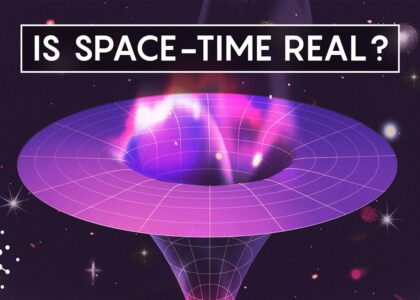
- Time behaves more like a dimension of space than a flowing river
If time can stretch, compress, and differ between observers, what exactly is flowing?
The Block Universe
Some physicists propose the “block universe” model:
- All moments—past, present, future—exist simultaneously
- Time does not move; consciousness moves through time
- The universe is a four-dimensional structure, already complete
In this view, the feeling of time passing is not a feature of reality—but a feature of awareness.
Quantum Physics and Timeless Laws
At the deepest level of physics, time nearly disappears. Many fundamental equations work perfectly without referencing time at all. Some approaches to quantum gravity describe the universe as fundamentally timeless, with time emerging only at higher levels of complexity.
If the universe’s most basic laws do not require time, then time may not be fundamental—it may be derivative.
4. Neuroscience: How the Brain Constructs Time
The brain does not measure time the way a clock does. Instead, it stitches together:
- Memory (past)
- Sensory input (present)
- Prediction (future)
This construction creates a continuous narrative—a sense of personal identity moving forward.
When this process breaks down:
- In deep meditation, time can vanish
- In flow states, hours pass unnoticed
- In certain neurological disorders, time fragments
These experiences suggest that time is less like an external force acting on the mind and more like a story the mind tells itself to maintain coherence.
Without memory, the past dissolves.
Without anticipation, the future disappears.
What remains is a raw, timeless immediacy.
5. Time as a Cognitive Survival Tool
From an evolutionary perspective, time may be a useful illusion.
Organizing reality into past, present, and future allows organisms to:
- Learn from previous outcomes
- Predict dangers
- Plan actions
But usefulness does not imply ontological truth. Just as color is a mental interpretation of electromagnetic waves, time may be an interpretation of change—not a property of reality itself.
The universe may simply be.
Only minds experience it as unfolding.
6. The Shadow of Time
If time is a mental construct, then what we live within is not time itself but its shadow—a psychological projection cast by consciousness onto a timeless reality.
This shadow governs:
- Fear of death
- Regret of the past
- Anxiety about the future
- The illusion of irreversible loss
To question time is not merely a scientific or philosophical exercise—it destabilizes identity, meaning, and mortality.
If time is not real in the way we assume, then neither is the rigid separation between what was, what is, and what will be.
Closing Reflection
The question “Is time real?” does not yield a simple answer. Time is undeniably real as an experience, yet increasingly questionable as a fundamental feature of the universe.
Perhaps time exists where consciousness exists—and nowhere else.
In the chapters that follow, Shadow of Time will explore what it means to live, suffer, remember, and hope within this illusion—and what may lie beyond it when the shadow begins to fade.